Monday, October 18, 2010

Sons and Mothers 


Much like Paul Morel, suffocated by his mother’s demands in the beloved
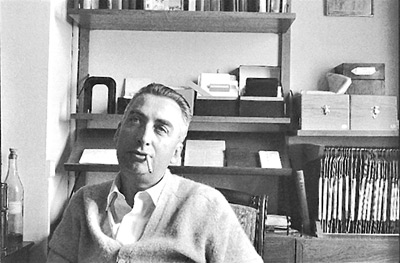
D.H. Lawrence novel, even after death there is no escaping Maman for the French literary critic and theorist, Roland Barthes. 


It has been 30 years since his death in 1980 (dying after being struck by a laundry van, walking home from a luncheon given by future French president, François Mitterrand), but Barthes has most recently published posthumously,
Mourning Diary—A once disembodied journal beginning the day after his mother’s death (documenting the emotional strain that ensued after), now pieced together by his former translator in life, Richard Howard. 


Barthes originally sealed his place in literary society with the essay “The Death of the Author,” essentially dissenting from traditional literary criticisms of his time. It can be summarized with a line taken from his essay referring to the “modern writer,” who is forever doomed to recycle what has already been written, repeating “a gesture forever anterior, never original.”


As if Barthes planned accordingly to disprove his most ardent critics, his most recent work is a testament to that very notion.
Mourning Diary, however, is not dedicated to revering the life he had shared with his mother (in fact it says very little about her), the late Henriette Binger Barthes, but is meant to encapsulate the loss he obsesses over, and never recovers from, years after her death.

It is not an original conceit as many other literary celebrities have long been noted for their notorious, albeit at times dysfunctional, affection toward their mothers (Truman Capote and Albert Camus being among those), but Barthes work reveals a hidden layer that cannot classify him as a typical mama’s boy. Upon her death he remarks he has “lost a daughter” (having cared for her meticulously as she was drying), but afterward he faced a new daunting task, testifying, “Henceforth and forever I am my own mother.”

Perhaps now with the publishing of his intimate agony, before kept secret from friends and contemporaries alike, a new genre might be popularized detailing the not-so-secret veneration between a boy and his mother.

Monday, October 11, 2010

Writing Until the Bitter End: A 30-Year-Feud in the Making


Last week marked only the second time in history a South American author has received the Nobel Prize in Literature.

Peruvian-born writer Mario Vargas Llosa, a onetime presidential candidate, was surprised last Thursday when it was announced he had won, joking, “I have taken all the precautions necessary for them never to give it to me,” in reference to his vigor stance in support of "democracy and the fr
ee market."—a stance that has vexed many in the realm of Peruvian politics.

Colombian native, Gabriel Garcia Marquez (affectionately known as Gabo), was a former friend and confidant of Vargas Llosa, and also was the first Latin American author to win the Nobel Prize in
Literature in 1982. Their longstanding friendship notoriously ended in 1976 after Vargas Llosa punched Garcia Marquez in the left eye at a Mexican cinema (rumors circulated that afterward he said, “That’s for what you did to Patricia.”)

No one knows for certain exactly who-did-what to Patricia (Vargas Llosa’s wife). The scenarios most commonly envisioned involve infidelity on the part of one of the men. It
was a toss up among presupposers as to whether Patricia was a participant (secretly involved with Garcia Marquez) or the two-timed victim of the saga (secretly being warned by Marquez of Vargas Llosa’s infidelity).

Others stand firm it was their ideological differences that drove a wedge. Vargas Llosa was steadily growing towards the political right while Garcia Marquez remained firmly planted in the left. Either way mutual friends have felt the tension and have been subjected to further awkwardness as attempts to reunite the former best friends are continuously foiled.

Both wish not to comment any further on the matter. Vargas Llosa had said in an interview, presumptuously, to let the “historians who deal with us” solve the mystery that has kept the literary world perplexed.

Vargas Llosa is now in his mid 70’s, and Gabo recently c
elebrated his 80th birthday. Prospects have continued to grow bleaker as both men have relocated to opposite ends of the earth. Vargas Llosa is now an adopted citizen of Spain, obtaining citizenship after losing the bid for presidency of Peru to Alberto Fujimori (the only elected president to ever perform a self-coup, only to be followed by a self-exile).

Garcia Marquez, who currently resides in Mexico, has reportedly begun writing again the second installment of his three-part autobiography. A noteworthy action considering the first installment, Living to Tell the Tale, was published back in 2002 and recounts his life up until the year 1955—years before the feud commenced.

The second installment is expected to be revelatory, but when questioned about the significance of the information he will have to impart unto his readers, Gabo’s reply remained nonchalant and unassuming, "I have realized that if I write the second volume, I will have to tell things that I do not want to tell about certain personal relationships that are not at all good."

Monday, October 4, 2010

Amazon’s Unexpected Promiscuity


Recently Amazon has come under fire for the
algorithms used to filter their search engines. If one is to type “homosexuality in books,” Amazon users are provided with A Parent’s Guide to Preventing Homosexuality as the top-ranking book in that category.

As the first book to be advertised, and a controversial one at that, it has unsurprisingly accumulated a large number of reviews. Out of 102 reviewers 46 gave it a five stars rating, marginally beating the one star rating given by 41. Reviewers only slightly deviate between the titles “Sick” and "Sick...” when naming the headline of their posts, but every now and then a title such as, “Excellent book, very informative!” pops up in between.

Amazon has long been an essential platform among book publishers, fostering book sales of a wide array of genres. So an algorithm inflicted with a case of homophobia is a Big Deal. And perhaps that’s why last week, at the Berlin International Literature Festival,
Canadian, Argentine-born author Alberto Manguel labeled “the American publishing industry…one of the worst and most dangerous things that has happened to the works of art and literature.”

So Amazon’s newfound sexual exploration, in the form of “Kindlerotica”, comes as a surprise when juxtaposed to their narrow-minded stance on “homosexual literature”. Last week,
Slate magazine published an article by James Ledbetter—“The Strange but Inevitable Rise of E-reader Pornography”—singling out the unprecedented influence Amazon has had on this genre. Ledbetter observes, “
The Kindle…pushes Amazon over the line from mere enabler of erotica to promoter and producer.”

In fact, Amazon frequently advertises free downloads in an effort to promote new authors. During the month of September,
Compromising Positions was the number one downloaded E-book, (the provided description warns possible downloader’s, “Kama Sutra isn’t for the prudish or faint of heart, and neither is this story”). However, this a relatively better choice in comparison to another featured offer Office Slave, a slightly varying version of erotic fiction except targeted towards a dominantly male audience (also casually classified under the “emotionally uncommitted genre”)—And yes, Office Slave is a self-explanatory title.

Amazon's peddling of free adult-themed literature continues unbeknownst to the their conservative consumer base. Amazon may be trying their hand to cater to their extensively diverse audience, but it won’t be long before someone realizes they're being two-timed.