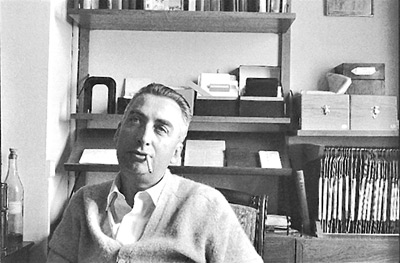
Much like Paul Morel, suffocated by his mother’s demands in the beloved D.H. Lawrence novel, even after death there is no escaping Maman for the French literary critic and theorist, Roland Barthes.
It has been 30 years since his death in 1980 (dying after being struck by a laundry van, walking home from a luncheon given by future French president, François Mitterrand), but Barthes has most recently published posthumously, Mourning Diary—A once disembodied journal beginning the day after his mother’s death (documenting the emotional strain that ensued after), now pieced together by his former translator in life, Richard Howard.
Barthes originally sealed his place in literary society with the essay “The Death of the Author,” essentially dissenting from traditional literary criticisms of his time. It can be summarized with a line taken from his essay referring to the “modern writer,” who is forever doomed to recycle what has already been written, repeating “a gesture forever anterior, never original.”
As if Barthes planned accordingly to disprove his most ardent critics, his most recent work is a testament to that very notion. Mourning Diary, however, is not dedicated to revering the life he had shared with his mother (in fact it says very little about her), the late Henriette Binger Barthes, but is meant to encapsulate the loss he obsesses over, and never recovers from, years after her death.
It is not an original conceit as many other literary celebrities have long been noted for their notorious, albeit at times dysfunctional, affection toward their mothers (Truman Capote and Albert Camus being among those), but Barthes work reveals a hidden layer that cannot classify him as a typical mama’s boy. Upon her death he remarks he has “lost a daughter” (having cared for her meticulously as she was drying), but afterward he faced a new daunting task, testifying, “Henceforth and forever I am my own mother.”
Perhaps now with the publishing of his intimate agony, before kept secret from friends and contemporaries alike, a new genre might be popularized detailing the not-so-secret veneration between a boy and his mother.

Margie, as you know, I love this blog. I really like your tag line - don't know if that's new or if Ijust noticed it, but it's wonderful. This one I feel like doesn't go far enough. Like you mention Capote and Camus and the character in the D.H. lawrence novel but don't give as specifics as to what you're referring to. I like this idea of authors and their mothers a lot. But it needs to be drawn out more. I don't feel you were actually saying anything about it. More hinting. Does taht make sense.
ReplyDeleteI like the post to the gaurdian about The Death of the Author - makes it contemporary.
go deeper next time..
B